Eliminate Communication Bottlenecks
Scattered emails, spreadsheets, and document repositories slow collaboration, delay approvals, and make critical information difficult to find.
Secure, centralized business portals designed to streamline collaboration, eliminate communication bottlenecks, and improve operational transparency.
Role-based environments designed to connect the right people with the right operational data.

Internal digital workspaces that centralize corporate communications, streamline HR processes, and connect distributed teams across your organization.

Secure, self-service environments where clients can manage accounts, track project progress, and interact with your team on their own schedule.

Collaborative platforms designed to automate supply chain interactions, standardizing invoice processing, compliance tracking, and order fulfillment.

Dedicated spaces for strategic partners to access shared marketing assets, register joint deals, and track collaborative performance metrics.

Focused environments that integrate directly with your inventory systems, providing suppliers with real-time forecasting and demand planning tools.

Specialized interfaces that reduce administrative overhead by empowering users to independently resolve common issues and access necessary documentation.
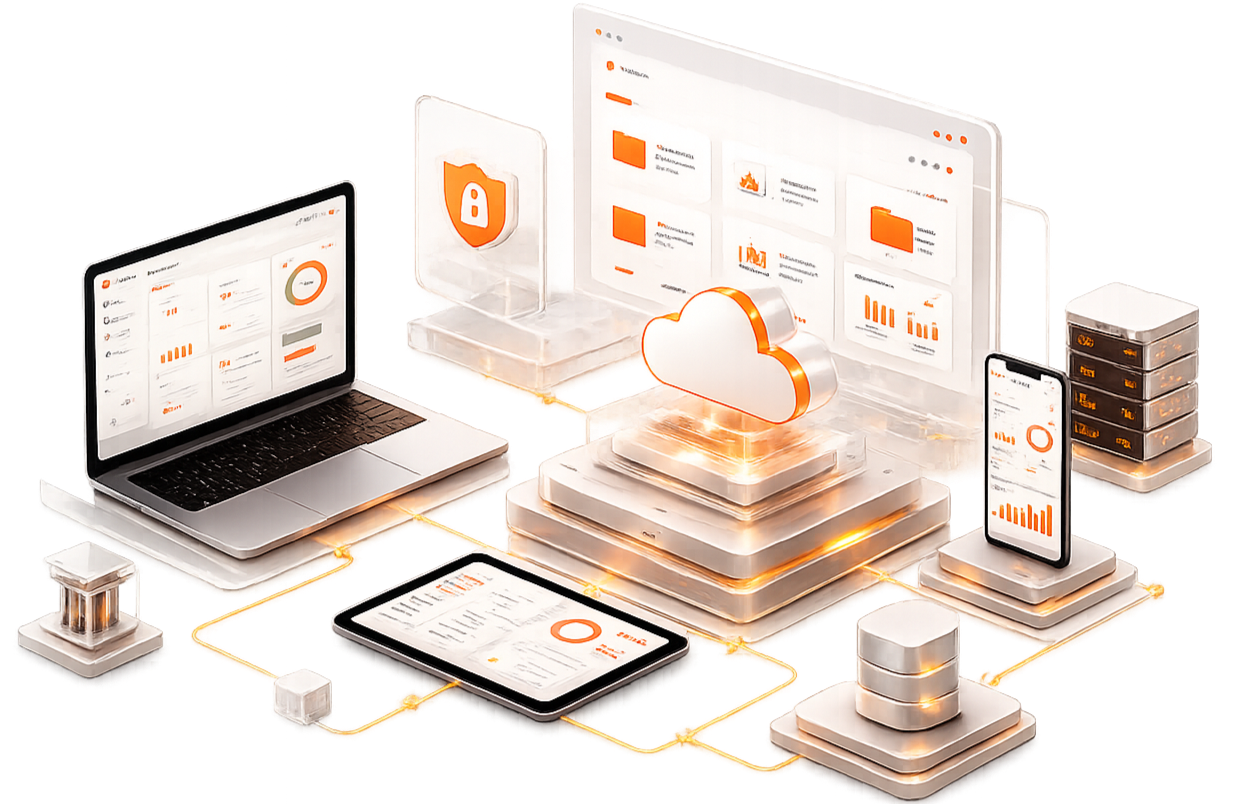
Scattered emails, spreadsheets, and document repositories slow collaboration, delay approvals, and make critical information difficult to find.
Custom business portals create secure, centralized spaces where authorized users can access the information, documents, and tools they need—reducing manual handoffs and keeping work moving.
Customer and Self-Service Portals let clients manage accounts, submit requests, and track progress independently. Partner Portals provide secure spaces for sharing resources, tracking joint metrics, and managing collaborative initiatives.
We build Employee Portals to centralize resources and onboarding, and Vendor and Supplier Portals to streamline orders, invoices, and inventory forecasting.
We map your business relationships, data access, and existing systems before development. This ensures your portal integrates with established workflows instead of becoming another disconnected platform.
We build secure gateways that protect your core systems while enabling frictionless business operations.

We analyze the relationships you need to support before recommending technical architecture, ensuring the portal actually improves operational flow.

Adoption dictates success. We design intuitive interfaces that require minimal training, encouraging frequent use by employees and external partners alike.

We implement robust authentication protocols and strict data isolation, ensuring external users only ever see the information they are authorized to access.

A portal should not be an isolated island. We build custom integrations to ensure data flows reliably between the portal and your existing ERP or CRM platforms.

Collaboration requirements evolve over time. We provide structured support and iterative development to ensure your portal adapts to changing business realities.

We build platforms that reflect your specific operational rules rather than forcing your business relationships into rigid, off-the-shelf software templates.
Hear from clients who’ve experienced remarkable transformations with Flipworks Technology.
Working with several word themes and templates the last years only can say this is best in every level use it for my company and the reviews that I have already are all excellent. Not only the design but the code

Working with several word themes and templates the last years only can say this is best in every level use it for my company and the reviews that I have already are all excellent. Not only the design but the code

Working with several word themes and templates the last years only can say this is best in every level use it for my company and the reviews that I have already are all excellent. Not only the design but the code

Working with several word themes and templates the last years only can say this is best in every level use it for my company and the reviews that I have already are all excellent. Not only the design but the code

Working with several word themes and templates the last years only can say this is best in every level use it for my company and the reviews that I have already are all excellent. Not only the design but the code

Working with several word themes and templates the last years only can say this is best in every level use it for my company and the reviews that I have already are all excellent. Not only the design but the code

I’ve tried several templates before, but this one stands out. It offers a perfect balance of aesthetics and performance. My team and I are extremely satisfied with how easy it is to use and customize. Truly a top-notch product!

This theme has exceeded my expectations in every way. The design is elegant, the code is clean, and the support is outstanding. It has helped my business grow, and the feedback from my customers has been overwhelmingly positive!

After using multiple website themes over the years, I can confidently say this is the best. It meets all my expectations in terms of design and functionality. My clients love the seamless experience, and I highly recommend it for anyone looking for quality
Got questions? We've got answers. Navigate the complexities of digital presence with ease.
Book a call with our friendly team to get all your questions and queries answered.
A custom portal eliminates the inefficiencies of scattered communication. By centralizing data access and automating routine interactions, you reduce administrative overhead, accelerate approval processes, and provide a significantly better experience for your staff and clients.
Employee portals focus on internal collaboration, HR processes, and corporate resource distribution. Customer portals prioritize external transparency, account management, and self-service support. Both require secure architecture, but the user journeys are entirely different.
Yes. Integration is a primary requirement for any effective portal. We build custom APIs that allow the portal to pull live data from your existing software, ensuring users always see accurate information without requiring manual data entry from your team.
Security is embedded at the architectural level. We implement zero-trust principles, granular role-based access controls (RBAC), and multi-factor authentication (MFA) to ensure that external vendors or clients cannot access unauthorized internal data.
We engineer portals using scalable cloud architectures. Whether you are onboarding ten new partners or a thousand new employees, the underlying infrastructure adapts to the load, maintaining consistent performance without structural failure.
Yes. We utilize responsive design methodologies to ensure the portal functions seamlessly across desktops, tablets, and smartphones, allowing field staff and traveling executives to access critical business data securely from anywhere.
Timelines vary based on integration complexity and feature scope. A focused vendor portal might be deployed in three to four months, while a comprehensive enterprise employee portal could take longer. We establish clear delivery schedules during the initial consulting phase.
Costs are driven primarily by the complexity of the required integrations, the strictness of compliance and security needs, and the depth of custom business logic required to support your specific workflows. We provide detailed projections aligned with expected business value.
Absolutely. The primary advantage of custom development is that the software conforms to your established business rules, approval hierarchies, and operational workflows, rather than forcing your team to compromise.
We build sophisticated administrative dashboards that give your internal team complete control over user access. You can define specific roles, restrict access to certain modules, and revoke permissions instantly when relationships change.
We provide structured Service Level Agreements (SLAs) tailored to the criticality of the platform. This includes proactive security patching, performance optimization, and regular infrastructure maintenance to ensure long-term reliability.
Yes. We build modular applications designed for continuous iteration. As your business needs evolve, we can expand the portal's capabilities, integrate new third-party tools, and adapt existing features without disrupting current operations.
Have a project in mind? Contact us for expert design and development solutions. Let's discuss how we can help grow your business.