
Business-First DevOps Strategy
We assess the specific delivery and operational problems your organization faces before recommending any tools or architectural changes, ensuring our implementation addresses the right constraints.
Build reliable, automated software delivery pipelines that eliminate manual deployment risk, accelerate release cycles, and give your engineering teams the operational foundation to move quickly without breaking things.
Automated pipelines and operational practices that remove the manual effort and coordination risk from software delivery.

Automated testing and deployment pipelines that validate every change before it reaches production and release software reliably without requiring manual coordination or extended deployment windows.

Version-controlled environment definitions that replace manual server configuration with repeatable, auditable infrastructure provisioning—eliminating environment drift and making infrastructure changes as consistent as application changes.

Application packaging and orchestration that standardizes how software runs across environments, enabling predictable deployments, efficient resource utilization, and straightforward scaling.

Automated provisioning, scaling, and management of cloud infrastructure that responds to operational demand without requiring manual intervention—keeping costs aligned with actual usage.

Real-time observability into application health, response times, and error rates that enables your team to identify and address production issues before customers are affected.

Security validation integrated directly into the delivery pipeline, ensuring vulnerabilities are identified and addressed at the development stage rather than discovered after they reach production.
When releases depend on manual coordination, software reaches customers slowly and deployment risks increase. Failed releases, difficult rollbacks, and lengthy deployment windows can limit your ability to respond to market needs.

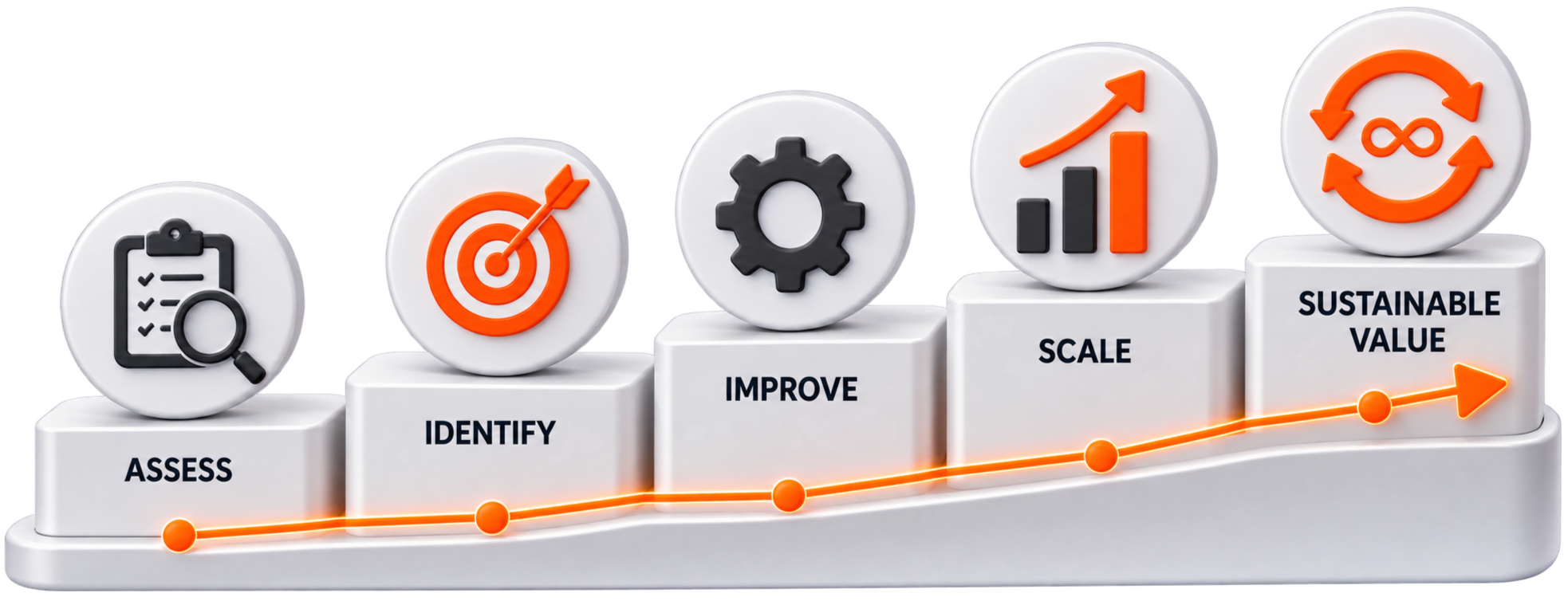
A connected path that improves efficiency, builds reliability, automates delivery, strengthens visibility and security, and creates a sustainable DevOps capability.
Manual deployment steps and infrequent releases allow changes and risks to accumulate. A streamlined delivery process helps teams release smaller improvements more frequently, reducing complexity and improving responsiveness.
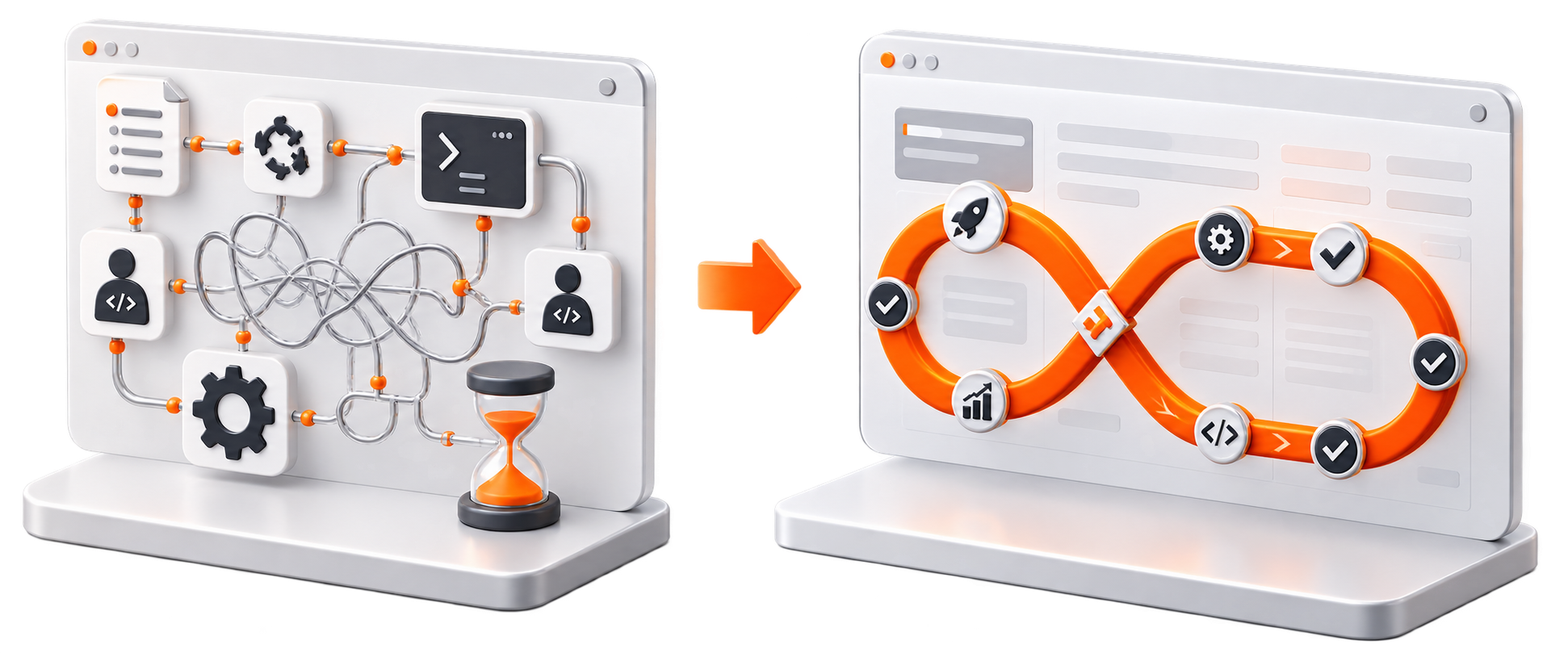
DevOps combines automation, governance, and shared operational practices to move software into production reliably and repeatedly. The result is faster delivery with greater confidence and less manual coordination.

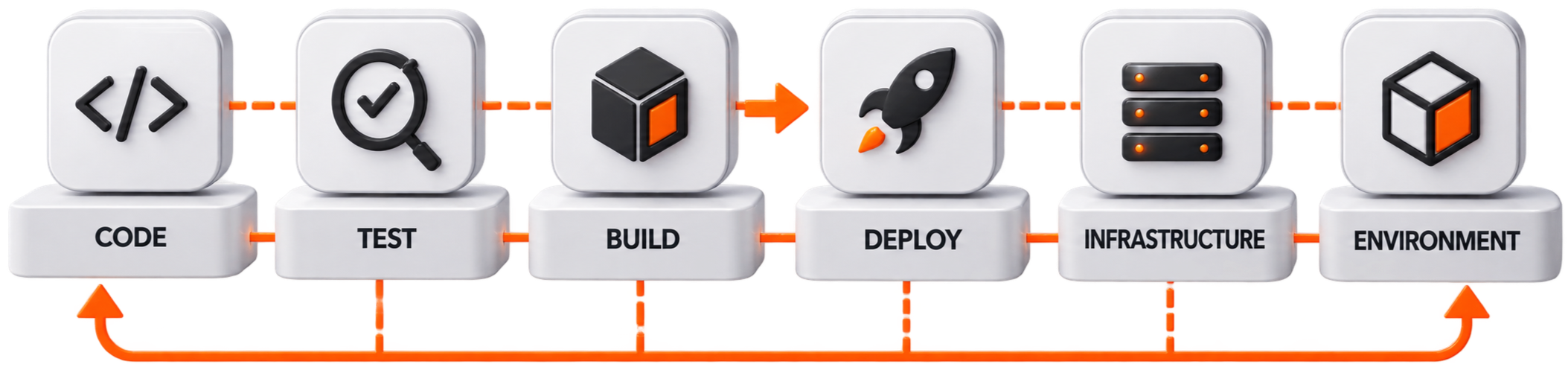
Our DevOps services include CI/CD Pipeline Implementation, Infrastructure as Code, and Containerization. We automate testing and deployment, create repeatable infrastructure, and standardize application environments for more predictable delivery.
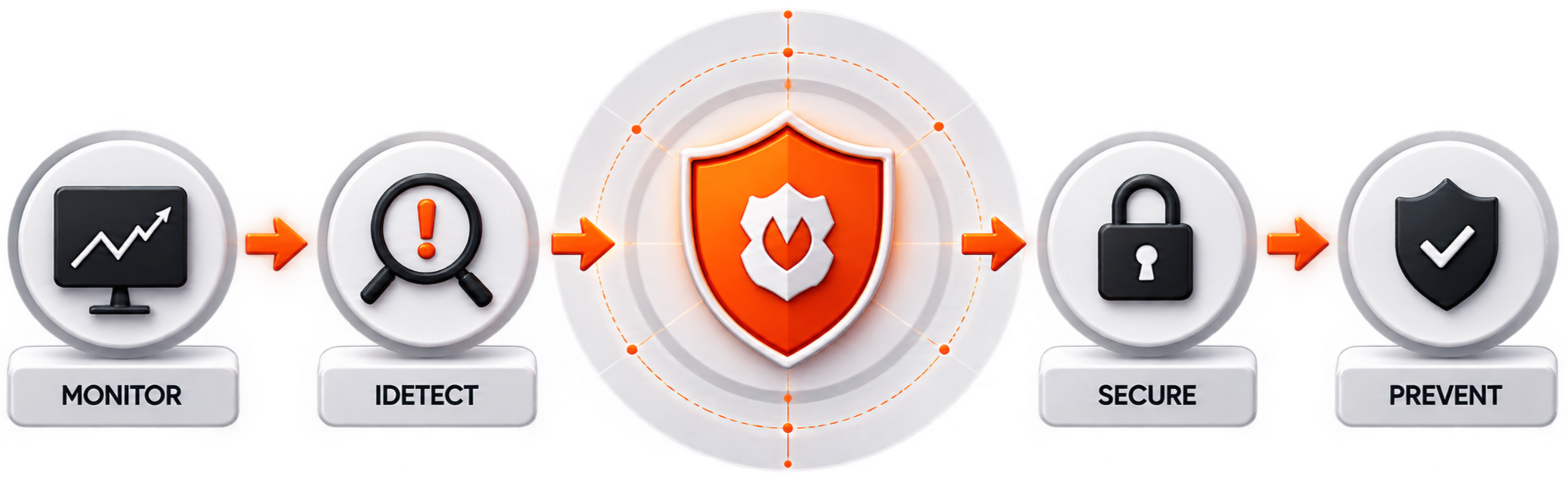
Monitoring and Performance Management provides real-time visibility into application health, performance, and errors. DevSecOps integrates security across the delivery pipeline, helping teams identify vulnerabilities before they reach production.
We assess your existing environment, identify the biggest delivery and operational gaps, and implement improvements in practical phases. The goal is a faster, more reliable delivery process that creates lasting business value.
We improve your delivery process before we change your infrastructure.
We assess the specific delivery and operational problems your organization faces before recommending any tools or architectural changes, ensuring our implementation addresses the right constraints.

We reduce the time between a completed feature and a deployed, validated production release—giving your product teams the delivery cadence required to respond to customer feedback and market conditions.

Automated, tested deployment pipelines replace the manual steps where most production failures originate—making each release predictable rather than an event that carries significant risk.

Security is integrated into every layer of the delivery pipeline and infrastructure configuration—not applied as a separate review process after deployment decisions have already been made.

We design cloud infrastructure and delivery pipelines that handle increased load without performance degradation, ensuring your operational foundation grows as smoothly as your product does.

DevOps environments require continuous refinement as technology and business requirements evolve. We maintain active operational partnerships that keep your delivery infrastructure current and your teams productive.
Hear from clients who’ve experienced remarkable transformations with Flipworks Technology.
Working with several word themes and templates the last years only can say this is best in every level use it for my company and the reviews that I have already are all excellent. Not only the design but the code

Working with several word themes and templates the last years only can say this is best in every level use it for my company and the reviews that I have already are all excellent. Not only the design but the code

Working with several word themes and templates the last years only can say this is best in every level use it for my company and the reviews that I have already are all excellent. Not only the design but the code

Working with several word themes and templates the last years only can say this is best in every level use it for my company and the reviews that I have already are all excellent. Not only the design but the code

Working with several word themes and templates the last years only can say this is best in every level use it for my company and the reviews that I have already are all excellent. Not only the design but the code

Working with several word themes and templates the last years only can say this is best in every level use it for my company and the reviews that I have already are all excellent. Not only the design but the code

I’ve tried several templates before, but this one stands out. It offers a perfect balance of aesthetics and performance. My team and I are extremely satisfied with how easy it is to use and customize. Truly a top-notch product!

This theme has exceeded my expectations in every way. The design is elegant, the code is clean, and the support is outstanding. It has helped my business grow, and the feedback from my customers has been overwhelmingly positive!

After using multiple website themes over the years, I can confidently say this is the best. It meets all my expectations in terms of design and functionality. My clients love the seamless experience, and I highly recommend it for anyone looking for quality
Got questions? We've got answers. Navigate the complexities of digital presence with ease.
Book a call with our friendly team to get all your questions and queries answered.
DevOps is the combination of practices, automation, and team culture that allows software to move from a developer's completed work to a running production environment reliably and frequently. In business terms, it means fewer deployment failures, faster feature releases, and engineering teams that spend their time building rather than managing unreliable delivery processes.
The competitive advantage in most software-driven businesses belongs to the organization that can respond to customer feedback and market changes the fastest. If your release cycle takes weeks or months, and a competitor can deploy daily, they will iterate and improve their product at a rate you cannot match with a slower delivery process.
Foundational improvements—a working CI/CD pipeline, automated testing, and basic infrastructure automation—can be implemented in six to ten weeks. Building a mature DevOps capability, including full Infrastructure as Code coverage, observability, and security integration, is typically a three to six month engagement.
Yes, substantially. Most production failures originate in manual steps that are inconsistent between deployments, or in code that was not tested adequately before release. Automated testing pipelines and repeatable deployment procedures eliminate most of the common failure causes and provide rollback capabilities that reduce the impact of the failures that do occur.
Yes. DevOps implementation is not an all-or-nothing proposition. We assess your current environment, identify the highest-risk gaps, and implement improvements incrementally—starting with the changes that deliver the most value while causing the least disruption to your active development and release operations.
We work with AWS, Microsoft Azure, and Google Cloud Platform, as well as hybrid environments that combine cloud and on-premise infrastructure. We recommend the platform or combination that best matches your workload requirements and existing technology investments.
Yes. Smaller teams often benefit more from DevOps practices because they have less capacity to absorb the cost of manual deployment coordination and production failures. Automation reduces the operational overhead per release, allowing a small team to maintain a consistent delivery cadence that would otherwise require significantly more people.
Yes. Automated testing in the CI/CD pipeline catches defects at the stage where they are cheapest to fix. Frequent small releases reduce the size and complexity of each deployment, making it easier to identify what caused a problem when one does occur. The combination consistently improves release quality over time.
We implement DevSecOps practices that integrate security scanning, dependency auditing, and configuration validation directly into the delivery pipeline. Security issues are identified before code reaches production rather than during a periodic audit after deployment decisions have already been made.
Both. Where your existing tools are appropriate for your delivery requirements, we build on them. Where gaps exist, we recommend tools based on your team's technical context, workload requirements, and long-term operational goals—not based on any commercial preference.
Yes. We offer ongoing managed DevOps services that include pipeline maintenance, infrastructure monitoring, security updates, and capacity planning. DevOps environments require active management as technology evolves, and we provide the operational continuity that keeps your delivery infrastructure running reliably.
We begin with a delivery process assessment that maps your current pipeline, identifies the specific failure points and bottlenecks causing the most business impact, and defines the implementation roadmap. This produces a clear, prioritized plan that your engineering leadership can review before any changes are made to your existing environment.
Have a project in mind? Contact us for expert design and development solutions. Let's discuss how we can help grow your business.