
Business-First Automation Strategy
We identify the workflows causing the highest operational cost before configuring any technology, ensuring every automation delivers a clear, measurable improvement to your business.
Replace manual coordination, fragmented email chains, and delayed approvals with intelligent workflows that move work forward automatically and give every team clear visibility into what is happening.
Automation designed around your real processes, not generic templates.

End-to-end digitization of complex multi-step operational processes, replacing manual coordination with structured, trackable workflows that run reliably without constant supervision.

Intelligent routing that delivers approval requests to the right person instantly, with automatic escalation if deadlines are missed—eliminating the delays that halt procurement, finance, and HR decisions.

Automated document generation, review routing, and digital signature collection that removes the manual handling from contracts, compliance records, and internal documentation cycles.

Structured employee lifecycle workflows that automate onboarding, offboarding, leave management, and compliance acknowledgments, allowing HR teams to focus on people rather than process management.

Automated invoice processing, expense approval routing, and reconciliation workflows that reduce administrative burden, minimize errors, and maintain a complete, compliant audit trail.

Intelligent workflow triggers that keep your customer and operational data synchronized across platforms, ensuring sales pipelines, inventory records, and customer communications remain accurate and current.

Work rarely slows because people lack effort. It slows between steps.
These gaps are the everyday cost of manually coordinating work across people, departments, and systems.
Workflow automation turns manual handoffs into structured, visible processes.
This keeps work moving even when employees are unavailable or busy.
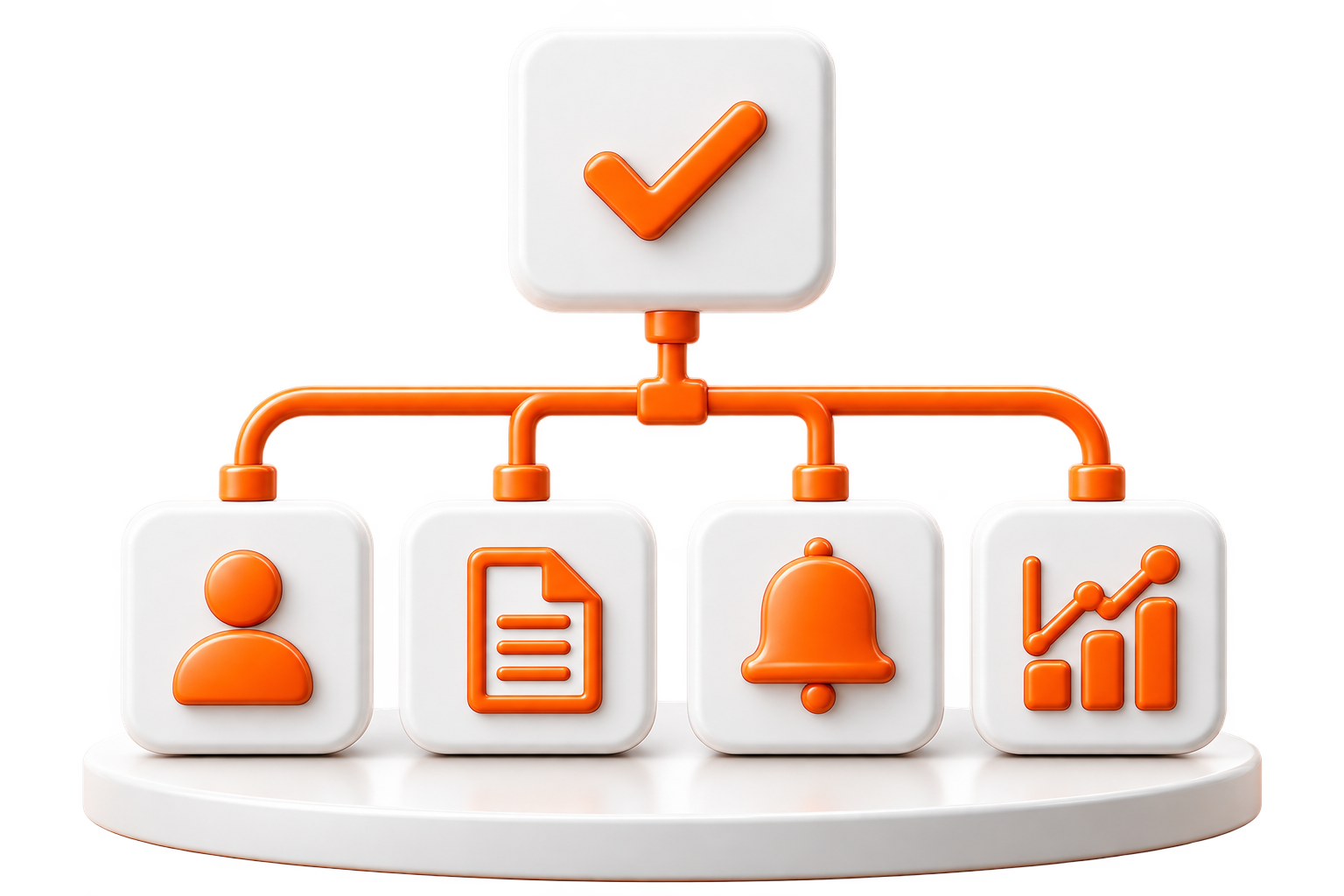

As part of our broader Business Automation services, workflow automation supports almost every operational function.
Well-designed workflow automation delivers measurable results:
Managers gain real-time status updates, while employees can focus more of their time on higher-value responsibilities.


Automation only works when the underlying process works.
This ensures automation solves operational problems instead of simply executing them faster.
Effective workflows must handle real-world complexity, including:
Automation should not make a process rigid. It should know when to proceed automatically and when to pause for human judgment.
This creates workflows that are both reliable and practical.
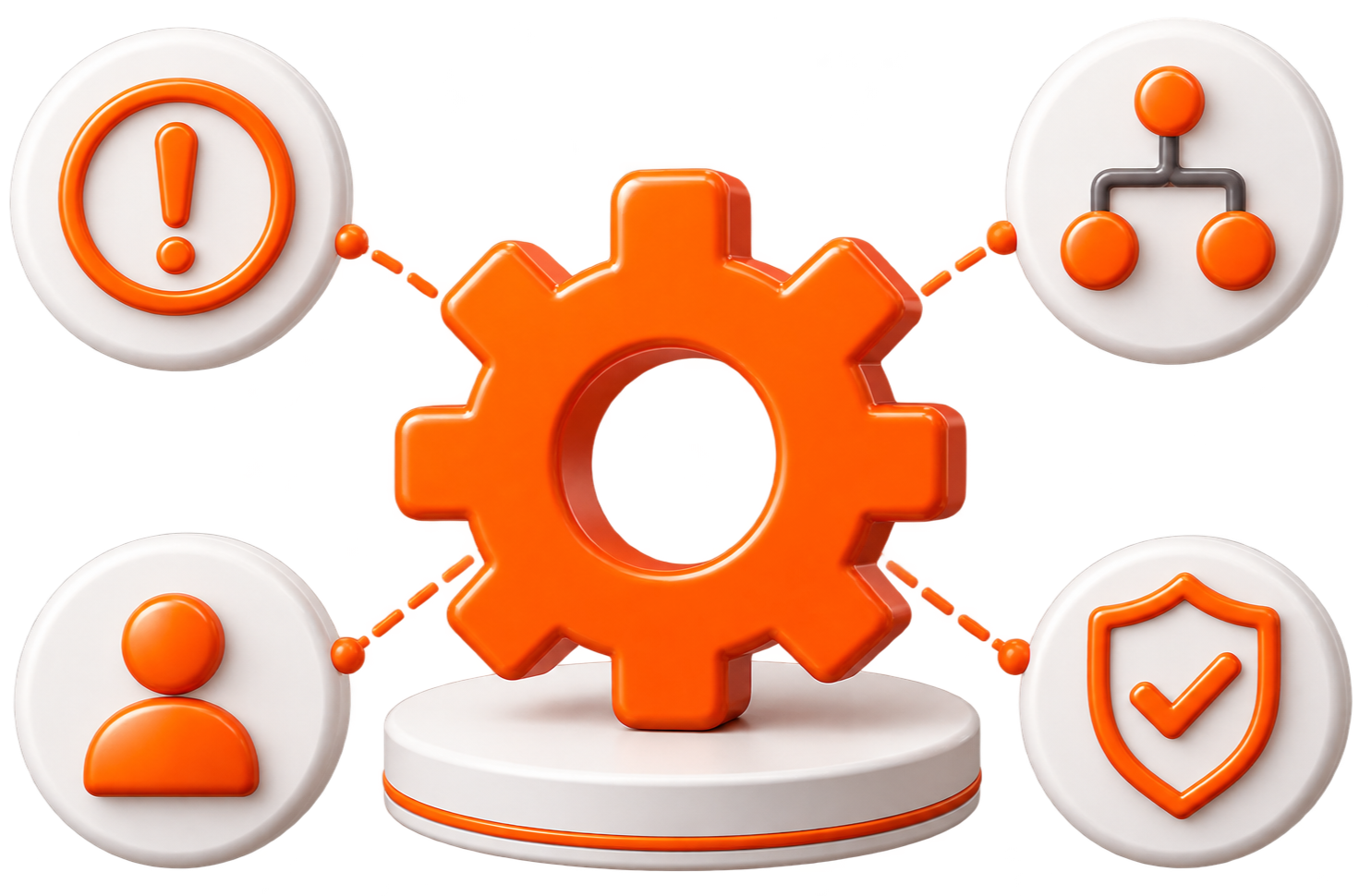
We invest in understanding your operations before building a single automation.
We identify the workflows causing the highest operational cost before configuring any technology, ensuring every automation delivers a clear, measurable improvement to your business.

We design every automation around your actual business rules, approval structures, and exception handling requirements—not generic templates that force your operations to fit the software.

Workflow automation is deployed in structured phases, keeping your operations running throughout implementation and allowing your teams to adopt new processes gradually rather than all at once.

Workflows designed with growth in mind. As your organization expands its teams, processes, and system integrations, the automation layer extends cleanly without needing to be rebuilt.

We connect workflows to your existing software through secure, authenticated API connections, ensuring sensitive operational data is protected at every point in the automated process.

Business processes change constantly. We maintain active partnerships to refine automation logic, expand coverage, and keep your workflows aligned as your operational needs evolve.
Hear from clients who’ve experienced remarkable transformations with Flipworks Technology.
Working with several word themes and templates the last years only can say this is best in every level use it for my company and the reviews that I have already are all excellent. Not only the design but the code

Working with several word themes and templates the last years only can say this is best in every level use it for my company and the reviews that I have already are all excellent. Not only the design but the code

Working with several word themes and templates the last years only can say this is best in every level use it for my company and the reviews that I have already are all excellent. Not only the design but the code

Working with several word themes and templates the last years only can say this is best in every level use it for my company and the reviews that I have already are all excellent. Not only the design but the code

Working with several word themes and templates the last years only can say this is best in every level use it for my company and the reviews that I have already are all excellent. Not only the design but the code

Working with several word themes and templates the last years only can say this is best in every level use it for my company and the reviews that I have already are all excellent. Not only the design but the code

I’ve tried several templates before, but this one stands out. It offers a perfect balance of aesthetics and performance. My team and I are extremely satisfied with how easy it is to use and customize. Truly a top-notch product!

This theme has exceeded my expectations in every way. The design is elegant, the code is clean, and the support is outstanding. It has helped my business grow, and the feedback from my customers has been overwhelmingly positive!

After using multiple website themes over the years, I can confidently say this is the best. It meets all my expectations in terms of design and functionality. My clients love the seamless experience, and I highly recommend it for anyone looking for quality
Got questions? We've got answers. Navigate the complexities of digital presence with ease.
Book a call with our friendly team to get all your questions and queries answered.
Begin with the processes that are causing the most operational pain—those that are high-volume, involve multiple people or departments, and regularly experience delays or errors. Common early wins are approval chains, employee onboarding, invoice processing, and customer service ticket routing.
Any process that follows a consistent sequence of steps with defined rules is a candidate. This includes document approvals, purchase order processing, employee lifecycle events, compliance reporting, customer communications, CRM pipeline updates, and interdepartmental data transfers.
No. The intention is to remove the administrative coordination burden that prevents people from doing meaningful work. When approvals route themselves and documents generate automatically, your team focuses on judgment, relationships, and strategy—the work that actually requires a person.
Yes. We design workflow automation to work with the systems you already have in place, connecting your CRM, ERP, HR platform, and accounting software through secure APIs. Replacing existing systems is rarely necessary.
A contained workflow for a single department—such as an approval chain or an onboarding sequence—can typically be delivered in four to eight weeks. Complex cross-departmental workflows involving multiple system integrations generally require two to four months in structured phases.
Security is built into every automation we design. We implement encrypted API connections, strict role-based access controls, and comprehensive audit logging. For regulated industries, we ensure workflows comply with relevant data protection and industry-specific compliance requirements.
The most consistent returns come from reduced processing time, fewer errors requiring correction, faster approval cycles, and recovered staff hours. We establish clear baseline measurements before implementation so that post-deployment improvements can be quantified accurately.
Yes. We build modular automation architectures that are designed to be adjusted. When your approval structures change, new steps need to be added, or new systems need to be connected, the workflow can be updated without dismantling the entire automation.
Investment depends on the complexity of the workflows, the number of systems involved, and the level of custom logic required. After a thorough scoping exercise, we provide transparent cost projections with a clear rationale for each component of the engagement.
Yes. We design approval workflows with full conditional logic—routing based on transaction value, department, approval hierarchy, or custom criteria. Escalation rules ensure that unresolved approvals do not sit idle indefinitely.
Often, yes. We can connect to legacy systems through available APIs, database access, or, where necessary, Robotic Process Automation (RPA) techniques that interact with older software interfaces directly. Our approach is always to work with your existing infrastructure rather than requiring you to replace it.
We provide structured post-deployment support that includes active monitoring, rule refinements as processes evolve, and proactive updates when connected systems change. We also conduct regular operational reviews to identify new automation opportunities as your business grows.
Have a project in mind? Contact us for expert design and development solutions. Let's discuss how we can help grow your business.